
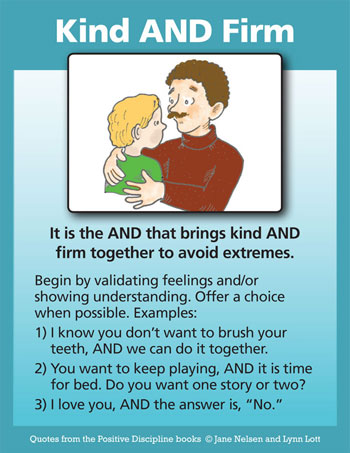
Rudolf Dreikurs taught the importance of being both kind and firm in our relations with children. Kindness is important in order to show respect for the child. Firmness is important in order to show respect for ourselves and for the needs of the situation. Authoritarian methods usually lack kindness. Permissive methods lack firmness. Kindness and firmness are essential for Positive Discipline.
Parents and Teachers struggle with this concept for many reasons. One is that they often don't feel like being kind when a child has "pushed their buttons." Again I want to ask, "If adults want children to control their behavior, is it too much to ask that adults learn to control their own behavior?" Often, it is the adults who should take some Positive Time-out until they can "feel" better so they can "do" better.
Many parents and teachers have mistaken notions about kindness. One of the biggest mistakes some parents and teachers make when they decide to try Positive Discipline is becoming too permissive because they don't want to be punitive. Some mistakenly believe they are being kind when they please their children, or when they rescue them and protect them from all disappointment. This is not being kind; it is being permissive. Being kind means to be respectful of the child and of yourself. It is not respectful to pamper children. It is not respectful to rescue them from every disappointment so they don't have the opportunity to develop their "disappointment muscles." It is respectful to validate their feelings, "I can see that you are disappointed (or angry, or upset, etc.)." Then it is respectful to have faith in children that they can survive disappointment and develop a sense of capability in the process.
Now let's take a look at being respectful to you. It is not kind to allow children to treat you (or others) disrespectfully. This is where it gets a little tricky. Not allowing children to treat you or others disrespectfully does not mean handling this situation in a punitive manner. Punishment is very disrespectful. So how do you handle it?
Let's suppose a child talks back to you. One kind and firm way to handle this is to leave the room. Oh, I can hear the objections: "But isn't that allowing the child to ‘get away with it?'" Let's take a closer look. You can't make another person treat you with respect, but you can treat yourself with respect. Walking away is treating yourself with respect–and is a strong model for children. You can always follow up later, when everyone has had a chance to calm down to feel better so they can do better.
Follow-up might look like this: "Honey, I'm sorry you were so angry. I respect your feelings, but not how you handled them. Whenever you treat me disrespectfully, I will just leave for a while. I love you and want to be with you, so when you are ready to be respectful you can let me know and I'll be happy to help you figure out other ways you can deal with your anger. Then we can focus on finding a solution that is respectful to both of us." It is best to let a child know what you are going to do in advance when everyone is calm.
It bears repeating that too many parents think they need to deal with the problem at the time of upset. This is the worst time to deal with a problem. When people are upset, they access their primitive brains, where the only option is fight (power struggles) or flight (withdraw and fail to communicate). It is not possible to think rationally when coming from our primitive brains. We say things we are later sorry for. It only makes sense to calm down until you can access your rational brain before you deal with a problem. This is a great skill to teach children. Sometimes it is better to "decide what you will do" (a tool you will learn more about in chapter five) than to try to make a child do something–at least until you can invite cooperation instead of a power struggle. So remember: kind equals respect.

Now let's tackle firmness. Most adults are used to thinking that firmness means punishment, lectures, or some other form of control. Not so. Firmness, when combined with kindness, means respect for the child, for you, and for the situation.
Let's take the situation of limits. Most parents decide what the limits should be and then take responsibility for enforcing them. But let's consider the purpose of limits. The purpose is to keep children safe and socialized. When adults set the limits and then enforce them with punishment, lectures, and control, they often invite rebellion and power struggles. This does not keep children safe or socialized. Instead, involve children when setting and enforcing limits. For example, you can brainstorm together what the limits should be for TV viewing, curfews, playtime away from home, or homework. Include children in a discussion (which means they talk at least as much, if not more, than you do) of why the limits are important, what they should be, and how everyone can be responsible to follow them. For example, when you ask children why homework is important, they will tell you "so I can learn" so I will get a better grade). They can then decide how much time they need and when is the best time for them. (Parents usually want their children to do their homework as soon as they get home from school. Children would usually like some downtime first. When children get some choice, they feel empowered.) Once they decide on the time that works best for them, you can both set some limits such as "TV for only one hour and only after homework is done. I will be available to help only between seven and eight, and will not give in to last-minute pleas for help during other times." Children are much more willing to follow limits they have helped create based on their understanding of why they are necessary and how to be responsible for them.
A word of warning: if children are used to lectures and punishment, they may say, "I don't know." This is the time for you to say, "You are such a good problem solver. Why don't you think about it and we'll get together in thirty minutes and you can let me know what you have come up with."
Parents and teachers habitually lecture and make demands. Children often respond by resisting or rebelling. The following kind and firm phrases will help you avoid disrespectful language and increase cooperation:
- Your turn is coming.
- I know you can say that in a respectful way.
- I care about you and will wait until we can both be respectful to continue this conversation.
- I know you can think of a helpful solution.
- Act, don't talk. (For example, quietly and calmly take the child by the hand and show him or her what needs to be done.)
- We'll talk about this later.
- Now it is time to get in the car. (When child is having a temper tantrum.)
- We need to leave the store now. We'll try again later (or tomorrow).
When you decide to stop being punitive, you will need to practice new skills. And you will need to take time for training to help children learn mutual respect and problem-solving skills.
Opposites Attract: When One Parent Is Kind And The Other Is Firm
It is interesting to note that two people with these opposing philosophies often get married. One has a tendency to be just a little too lenient. The other has a tendency to be just a little too strict. Then the lenient parent thinks he or she needs to be just a little more lenient to make up for the mean old strict parent. The strict parent thinks he or she needs to be just a little more strict to make up for the wishy-washy lenient parent—so they get further and further apart and fight about who is right and who is wrong. In truth they are both being ineffective.
One way to help children and parents learn effective communication is to have regular family or class meetings where they have an opportunity, on a weekly basis, to brainstorm for solutions to problems and to choose the solutions that are respectful to everyone. Focusing on solutions is one of the best ways for "opposites" to get closer together and be supportive of each other and their children.
Click Here to Learn More About the Sproutable Online Course for Parents of Young Children!

Comments
The needs of the child or of the adult?
After being with children for over 36 year, guiding, administrating, and working deeply with families, I find the context of this video is very adult focused. Children move through moments in fluid ways and the manner in which this adult continually keeps trying to bring the child back to a past moment, is a wonder to me. It shows how little tolerance many adults have to being in the present moment of the child without an agenda.
Rules are agendas to me and I have never used this word with children or adults. We exist in collaboration so words that are process centered such as, agreements, seem more natural. I see reaction in this child from being told what she is feeling as well...which I have never done as a parent, grandp, consultant, and PD parent educator.
In all...so many words, so much happening and I see a child who is lost in the needs of the adult.