
Class meetings invite students to learn by doing. They provide the practice arena for all of the skills necessary to grow citizens who are responsible, respectful and resourceful members of the community.
The Positive Discipline vision is about schools where children never experience humiliation when they fail but instead feel empowered by the opportunity to learn from their mistakes in a safe environment. Many of the social and emotional skills students learn are represented in the Significant Seven Perceptions and Skills.
Three Empowering Beliefs That Help Children Succeed in School and in Life
- I am capable.
- I contribute in meaningful ways, and I am genuinely needed.
- I use my personal power to make choices that positively influence what happens to me and my community.
Four Empowering Skills That Help Children Succeed in School and in Life
- I have discipline and self-control.
- I can work respectfully with others.
- I understand how my behavior affects others.
- I can develop wisdom and judgment skills through daily practice.
Here is a description of how Positive Discipline methods teach the Significant Seven.
 I Am Capable
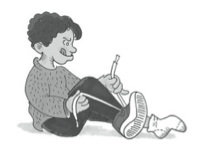
To develop a belief in their own personal capability, young people need a safe climate in which they can explore the consequences of their choices and behavior without judgments about success or failure— without blame, shame, or pain. Positive Discipline methods provide a safe climate in which students can examine their behavior, discover how it affects others, and engage in effective problem solving to create change.
I Contribute In Meaningful Ways, And I Am Genuinely Needed

I Use My Personal Power To Make Choices That Positively Influence What Happens To Me And My Community
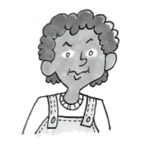
Many teachers fail to understand that students have personal power and will use it in one way or another. If they are not given opportunities to use it in productive ways, they will probably use it in destructive ways. Young people, to develop a healthy use of power in their lives, need the opportunity to contribute in useful ways, in an environment that encourages them but also holds them accountable. They need to learn to understand and accept their power to create a positive environment. A Positive Discipline classroom is a place where students can experience that it is okay to make mistakes and to learn from those mistakes. In Class Meetings, they learn to take responsibility for their mistakes (accountability), because instead of being punished, they receive assistance in exploring ways to learn from their mistakes. They also learn that even when they can’t control what hap- pens, they can control their response to what happens.
I Have Self-Discipline And Self-Control

I Can Work Respectfully With Others

I Understand How My Behavior Affects Others
I Can Develop Wisdom And Judgment Skills Through Daily Practice
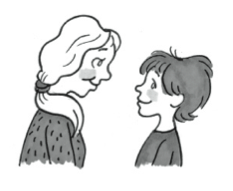
Young people develop judgment skills only when they have opportunities to evaluate problems by being socially conscious and aware of what is happening around them. When a problem develops in a Positive Discipline classroom, students explore what happened, what caused it to happen, how their behavior affects others, and what they can do to prevent or solve such problems in the future. In this way, they learn to respond to the needs of the situation.
Students who are weak in the development of these three beliefs and four skills are at high risk for developing serious problems such as bullying, drug abuse, teen pregnancy, suicide, delinquency, and gang involvement. They are also at risk for developing less serious but very annoying beliefs such as a sense of entitlement and a lack of motivation. Students with strengths in the Significant Seven are at low risk for developing these serious and annoying problems. Obviously, it is extremely important that young people have the opportunity to learn the Significant Seven, and Positive Discipline provides an excellent opportunity to do so.
Putting it All together
Positive Discipline is effective when teachers are willing to work with students in a cooperative manner. Teachers who learn how to ask more questions and give fewer lectures develop a real curiosity about their students’ thoughts and opinions. When students are encouraged to express their opinions, are given choices instead of edicts, and use group problem solving, the classroom atmosphere improves and becomes one of cooperation, collaboration, and mutual respect.
Even though it may be challenging at times to start Class Meetings, we encourage you to do so. Taking the time for training is the surest route to success. Achieving proficiency in the eight skills, found in this chapter and Chapter 12, will help create Class Meetings in which students want to become involved. You have already been teaching your students about problem solving, social interest, mutual respect, encouragement, and cooperation. All these skills are enhanced and practiced during Class Meetings.
It can take anywhere from three or four Class Meetings to two months of forming a circle and introducing the eight skills to students. They won’t be able to learn social and emotional skills in a few weeks. They need daily practice—just as they do for excellence in academics. If you introduce the skills gradually, students will be less restless about them and will be able to practice them a few at a time. Start by letting your students know what skills they will be learning.
The Eight Skills for Class Meetings
- Forming a Circle
- Practicing Compliments and Appreciations
- Respecting Differences
- Using Respectful Communication Skills
- Focusing on Solutions
- Role-playing and Brainstorming
- Using the Agenda and Class Meeting Format
- Understanding and Using the Four Mistaken Goals
Students learn:
- To use their voice
- To practice looking at issues from multiple points of view
- That mistakes are opportunities to learn
- To see strengths in themselves and others
- How collaboration can change things
- That they have influence in a socially useful way
- What it feels like to set goals, plan and be able to carry out the plan.
Click Here to learn more about Positive Discipline School and Classroom resources.
Classroom Educator Certification Training
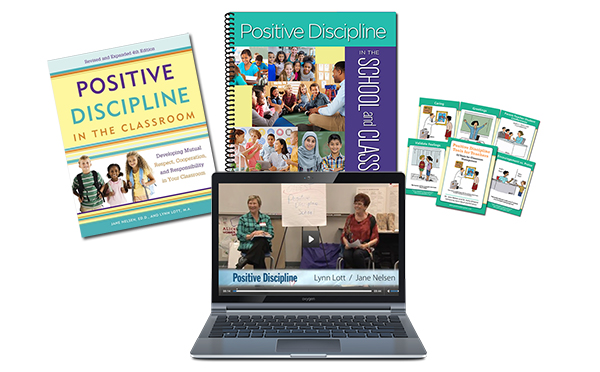
Hundreds of schools worldwide use these amazingly effective Positive Discipline strategies for restoring order and civility in today's turbulent classrooms. Now you too can use this philosophy as a foundation for fostering cooperation, problem-solving skills, and mutual respect. Just imagine, instead spending your time energy trying to manage and control misbehavior, you can enjoy teaching. Instead of confronting apathy, you will enjoy motivated, eager, engaged students! Inside you'll discover how to:
- Create a classroom climate based on community and cooperation that enhances academic learning.
- Use encouragement to increase students’ intrinsic motivation.
- Instill valuable social and emotional life skills and positive behavior through the use of class meetings.
- Understand the motivation behind students' behavior instead of looking for causes.
And much more!
13 Hours of CE Credit available.